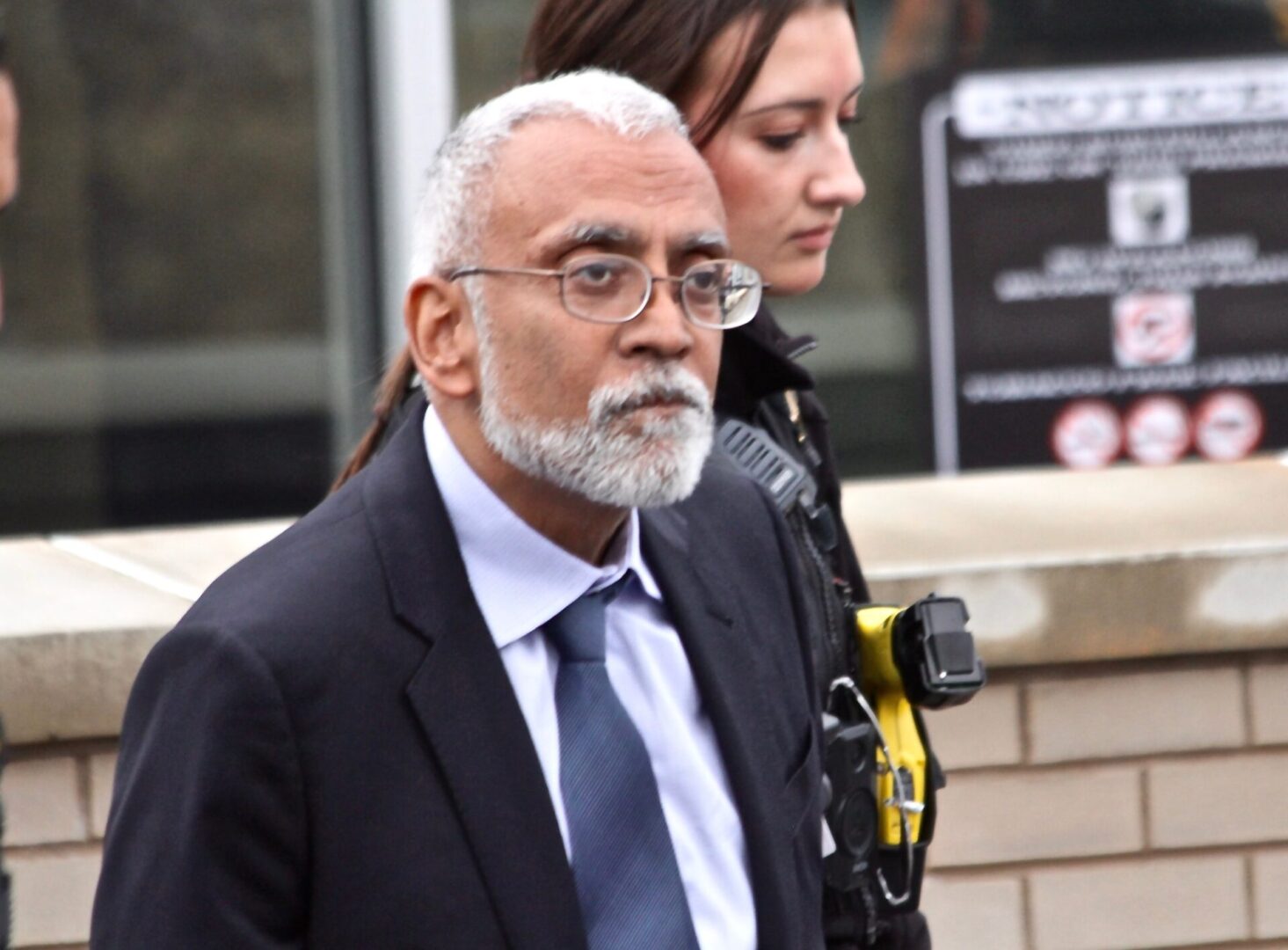
The State College man who spent more than 40 years in prison on a now-overturned murder conviction only to be detained by immigration authorities upon his release has won a major victory toward earning his freedom.
A federal immigration judge on Thursday granted Subramanyam “Subu” Vedam‘s petition for a waiver from deportation for a separate, decades-old drug conviction, saying that the 64-year-old remaining in the country “would be in the best interest of the United States.”
“The court finds that [Vedam’s] genuine rehabilitation, consistent display of good moral character over the last 40 years and strong family ties and communal support, and the court’s predictive finding of [his] contributions to American society in the future have, in the court’s judgment, overcome the negative weight of his criminal history in this case,” Immigration Judge Adam Panopoulos said.
While the decision puts Vedam a giant step closer to walking free for the first time since his arrest in 1982, the Department of Homeland Security still has 30 days to appeal the decision. Vedam’s attorneys said they will file a request on Friday seeking his release on bond from the Moshannon Valley ICE Processing Center during that period.
Panopoulos read his decision a day after a hearing in which Vedam testified, via videoconferencing, for the first time since his trials in the 1980s for the murder of Thomas Kinser.
“We’re profoundly grateful to Judge Panopoulous not only for affording Subu the justice he had been deprived over so many decades, but also for seeing him as the honorable, compassionate, conscientious man he has always been,” Saraswathi Vedam, Subu’s Vedam’s sister, said in a statement.
Vedam was exonerated of Kinser’s murder in 2025 after a Centre County judge found that ballistics evidence withheld from his original 1983 trial and 1988 retrial could have swayed the jury to find him not guilty. With the conviction vacated, District Attorney Bernie Cantorna dropped the charges, and Vedam was set to be released from Huntingdon state prison on Oct. 3.
On the day of his release, however, he was taken into custody by Immigration and Customs Enforcement on a 1999 deportation order. After being convicted in 1983 for Kinser’s murder near State College, Vedam resolved a separate, earlier case by entering a no contest plea to four counts of selling LSD when he was 19 years old, a conviction that formed the basis for the government’s effort to remove him from the country.
ICE has sought to deport him to India, where he was born in 1961 during a brief period when his parents returned to their home country. Vedam, however, moved to State College with his family when he was nine months old and was a green card holder, or lawful permanent resident, days away from earning his citizenship when he was arrested in 1982.
Vedam said on Wednesday that he never thought of himself as anything other than a U.S. resident, does not speak any of India’s languages and has no immediate family there.
Lawful permanent residents convicted before 1997, when stricter new immigration laws went into effect, can be granted relief from deportation for certain crimes at the discretion of an immigration judge.
Ruling in favor of Vedam’s petition, Panopoulous cited Vedam’s close bond with his sister and nieces, extensive support system and exemplary record during his incarceration. During his time at Huntingdon, he earned three degrees, including a master’s, developed literacy programs, organized an annual run benefiting Big Brothers Big Sisters and tutored and mentored other inmates.
“He made a choice to live his life in a particular way,” Panopoulous said. “The choices that he did make consistently point to a man who has good moral character. He never engaged in any fights and was never accused of violence of any kind. He felt compelled to act in response to what he saw as injustices within the prison system, such as the high rates of illiteracy in the prison population. He dedicated himself to connecting with his U.S. citizen family members, just as if he was not inside prison and was building those relationships with his family members throughout his life. He consistently read and studied to sharpen his mind and achieve advanced degrees.
“All this evidence taken together indicates to this court that [Vedam], from his 20s until his mid-60s, took actions that objectively demonstrate that he is a person of good moral character.”
At Wednesday’s hearing, DHS attorney Tammy Dusharm said Vedam had gone on a “crime spree” when he was in his late teens from 1980 to 1982, including a DUI charge and conviction for receiving stolen property, in addition to selling LSD.
Panopoulous, though, sided with Vedam and his immigration attorney, Ava Benach, who said those were poor choices of a teenager that he has taken responsibility and atoned for over decades in a maximum security prison for a conviction that is now vacated.
“I was young and stupid,” Vedam said. “I don’t think that that year and a half or two years is reflective of who I am and the totality of my life. You know, I’ve done good things in my life. I believe I’ve led a life that is something good and contributes to society, contributes to my community. I don’t think that those two years that were somewhat aimless and without focus is who I am and who I want to be.”
Since he was taken into custody by ICE, Vedam was transported from the Moshannon Valley facility to Texas then Louisiana in preparation for his removal. He was then returned to Clearfield County after a federal district court granted an emergency stay.
The U.S. Justice Department’s Board of Immigration Appeals in February put a moratorium on ICE’s efforts to deport Vedam while his case proceeded through immigration court.
“Given the facts and circumstances in this particular case, we conclude that the record before us presents an exceptional situation,” Temporary Appellate Immigration Judge Paul A. McCloskey wrote in the opinion explaining the decision.
Later in February, New Jersey-based Immigration Judge Tamar Wilson denied Vedam’s request to be released on bond, ruling that she did not have jurisdiction to do so because of his conviction on drug charges, felonies that she said make him subject to mandatory detention.
If Panopoulous’ decision holds, Vedam said that he plans to live with one of his nieces in Sacramento, California where he will be an “uncle nanny” for her 18-month-old daughter. He said he also has been offered a spot in a Ph.D. program and teaching assistantship at Oregon State University.
“Despite being 64 years old, the court is struck by [Vedam’s] desire to start his life fresh and contribute intellectually to the growth of a new generation of American students,” Panopoulous said.
Saraswathi Vedam said she and her family are grateful that Panopoulous considered the totality of her brother’s life.
“We had dared to dream that this day would come, sharing Subu’s belief that the truth would prevail,” Saraswathi Vedam said. “Even through 44 years of setbacks, Subu never let it defeat his spirit. Though sentenced wrongly to life without parole, he lived an exemplary life of service and education.Today’s decision was possible because the judge took the time to review his record with care, so he could understand how Subu Vedam transcended injustice to leave such a positive imprint on those around him.”